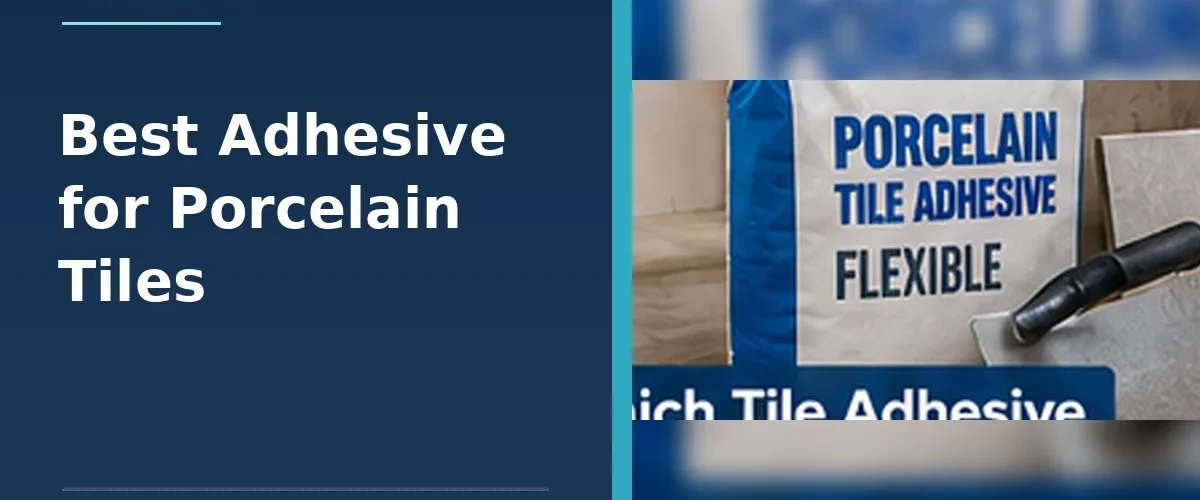
For most porcelain floor tiles and many larger porcelain wall tiles, a suitable cement-based powder adhesive is a more dependable starting point than a general-purpose ready-mixed tub. Porcelain’s low water absorption means that some dispersion adhesives can dry too slowly, particularly behind large tiles or over waterproof membranes. Always choose a product approved for your specific tile, substrate and location.
Why is porcelain different from ceramic?
Porcelain tiles are dense and typically have low water absorption. The adhesive needs to bond effectively to the back of the tile and the substrate without relying on moisture escaping through the tile. An adhesive that performs well with small, porous ceramic wall tiles may be unsuitable for a large porcelain panel.
Powder versus ready-mixed tile adhesive
| Type | Where it may be appropriate |
|---|---|
| Cement-based powder adhesive | Widely used for porcelain floors, large-format wall tiles, suitable wet zones and many demanding substrates, subject to classification. |
| Ready-mixed dispersion adhesive | Selected smaller wall tiles and approved interior conditions; generally not the default for large porcelain or continuously wet floors. |
| Reaction-resin adhesive | Specialist environments requiring particular chemical resistance or performance, where specified. |
What do C1, C2, S1 and S2 mean?
Packaging may carry classifications to BS EN 12004. C indicates a cementitious adhesive; C2 identifies improved adhesion performance within the standard; S1 and S2 identify levels of deformability where tested. Other markings may cover fast setting, extended open time and slip resistance. An S1 product is not a substitute for a stable substrate or properly designed movement joints.
Not every tile installation needs the most expensive highly deformable adhesive. Match the classification to the tile size, wall or floor, membrane, heating system and manufacturer’s specification.
How to choose adhesive step by step
- Identify the tile. Check porcelain type, dimensions, thickness, weight and the profile of the back.
- Identify the substrate. Concrete, plasterboard, screed, backer board and membranes have different preparation and compatibility requirements.
- Check exposure. Shower floors, external areas and heated floors may demand a different system from a dry kitchen wall.
- Select the classification. Read the product’s technical data sheet for tile type, size, bed thickness and service conditions.
- Check adhesive coverage. Use a suitable trowel and lift a trial tile to check that the ridges have collapsed and edges are supported.
- Respect set and cure times. Don’t grout or use a shower earlier than the overall system allows.
What about porcelain tiles over underfloor heating?
Heated floors experience thermal movement. The adhesive, screed, any membrane and movement joints must be specified as a system. Commission and switch off underfloor heating before work according to the system guidance, then bring the temperature back up gradually after curing.
Common mistakes to avoid
- Using ordinary wall tile adhesive for large porcelain floors.
- Assuming ‘flexible’ adhesive can compensate for a bouncing floor.
- Choosing only by price rather than installation conditions.
- Dot-and-dab fixing instead of creating a solid supported bed.
- Leaving dust on tile backs or failing to prime an absorbent substrate when specified.
Frequently asked questions
Can I use ready-mixed adhesive for porcelain tiles?
Only if the particular product expressly permits the size, background and exposure. Many large porcelain and floor applications call for a suitable cement-based adhesive.
Do porcelain tiles need flexible adhesive?
It depends on the floor or wall construction, tile format and expected movement. Consult the manufacturer’s prescribed class, especially for heated floors.
Can you use the same adhesive in a shower?
Only if compatible with the waterproof membrane, tiles, substrate and wet-area service conditions.
What happens if I use too much adhesive?
Exceeding the permitted bed thickness can lead to shrinkage, uneven tiles or poor performance. Correct the substrate before tiling.
Further reading: The Tile Association: large-format porcelain tiles; adhesive drying times.