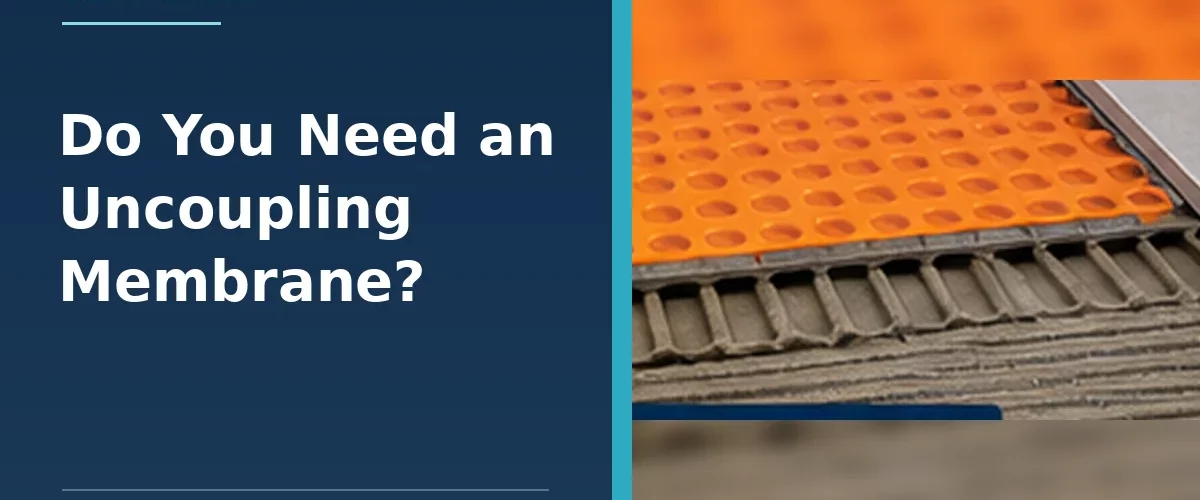
An uncoupling membrane is a layer installed between the substrate and the tiled finish to help manage certain movements and stresses. It can be useful on appropriate timber-based constructions, heated floors and some screeds, but it is not required for every tiling job—and it cannot make an unstable floor structurally sound.
How does an uncoupling membrane work?
Different membranes use cavities, fleece or other engineered layers to manage limited movement between the substrate and the tiles. Some products also offer waterproofing or vapour-management benefits, but only when installed with the required joint tape, seam treatment and compatible materials.
When might you need one?
Timber-based subfloors
UK guidance following BS 5385-3:2024 recommends appropriate intermediate layers when tiling onto wood-based sheets and boards. An approved uncoupling membrane may be one part of that system. The timber still needs suitable stiffness, fixings and support.
Underfloor heating
Heating and cooling can create stresses. A compatible membrane may be specified to manage some differential movement, in combination with suitable adhesive, screed and movement joints.
Some existing screeds
Specialist systems may accommodate limited shrinkage or small non-moving cracks in an assessed substrate. Membranes do not bridge actively moving structural defects without an engineered design.
Waterproof bathrooms or wet rooms
Some membranes are also waterproof. However, a waterproof membrane needs a continuous, correctly sealed system at seams, drains, corners and penetrations. Do not assume every uncoupling mat provides wet-room tanking.
When an uncoupling membrane won’t help
- Rotting or inadequately supported timber.
- A floor that bounces visibly underfoot.
- Active structural cracks that require repair.
- A screed that is too damp or too weak for the specified system.
- Missing movement joints in the tiled finish.
- Poor bedding of large-format tiles.
How to select a membrane
- Identify the substrate and its structural condition.
- Confirm tile size, material, service load and expected movement.
- Check whether waterproofing or a heating system is involved.
- Review the membrane manufacturer’s permitted backgrounds and adhesive types above and below the membrane.
- Check seam, perimeter, movement-joint and termination details.
- Confirm the total build-up height and cure times.
Basic installation sequence
Prepare and level the substrate first. Apply the adhesive specified beneath the membrane and install it in the correct orientation with full contact, avoiding trapped air. Treat seams and waterproof junctions only as required by the system. Allow necessary curing, then fix tiles with a compatible adhesive using the system’s bedding instructions.
Frequently asked questions
Do I need uncoupling membrane on concrete?
Not automatically. Consider the age, movement, condition and moisture of the concrete alongside the manufacturer’s system recommendations.
Will an uncoupling membrane stop all cracks?
No. It may reduce stress transfer but cannot prevent every failure or correct structural movement.
Can I use a membrane instead of backer board?
Sometimes within a specified build-up, but membranes generally do not contribute the structural stiffness provided by a suitable board system.
Is a decoupling membrane the same thing?
The terms ‘uncoupling’ and ‘decoupling’ are often used interchangeably in the tiling industry; compare the actual product performance.
See The Tile Association’s 2024 standards update and our timber floorboards tiling guide.