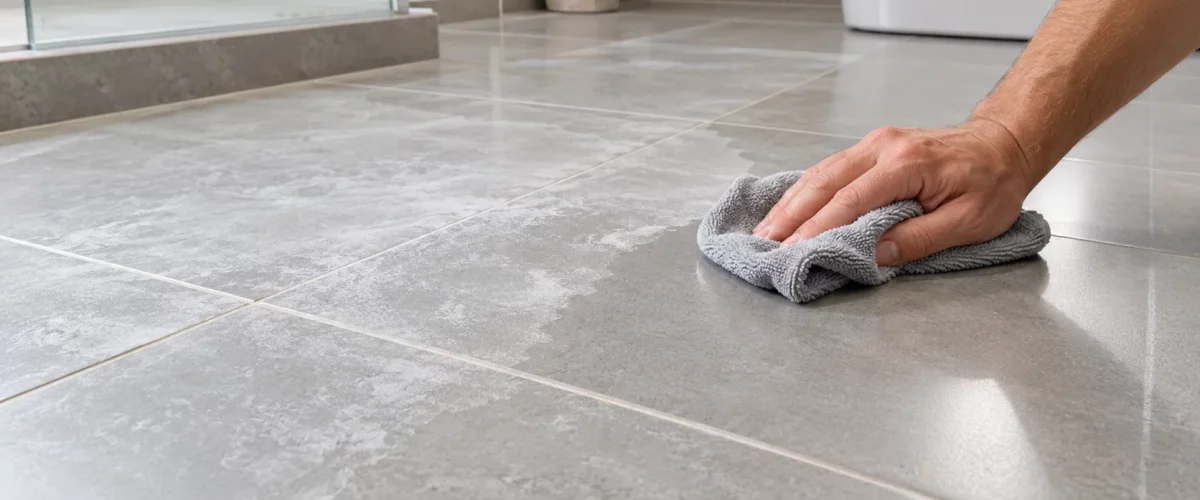
Grout haze is the fine, cloudy film left on tile faces after grouting. On porcelain tiles it may look like white dust, a streaky coating or a patch that appears clean when wet but turns dull again as it dries. The right removal method depends on whether the residue is still fresh, whether it is cement-based or epoxy grout, and the tile’s surface finish.
Start with the gentlest method that works. Aggressive scrubbing and unsuitable acid-based cleaners can permanently mark some tile finishes, grout and surrounding materials.
What causes grout haze on porcelain tiles?
When you spread grout between tiles, a thin layer can remain on their faces. Normal wash-off removes most of it, but an excessively wet sponge can spread cement particles into a larger film. Residue becomes harder to remove as it cures. Textured and anti-slip porcelain can trap haze in tiny surface recesses, while polished porcelain shows streaks particularly clearly.
Before you clean, identify the grout used. Cement-based haze and epoxy resin film need different products. If you don’t know what grout was used, ask the installer or check the packaging rather than guessing.
What you’ll need
- Two buckets of clean water and clean, non-abrasive microfibre cloths
- A soft nylon brush or white non-scratch pad approved for the tile finish
- Protective gloves and, where specified by the cleaner, eye protection
- A grout-haze remover explicitly compatible with your tile, grout and any sealant
- A wet vacuum or absorbent cloths for removing dirty cleaning liquid
How to remove fresh grout haze
- Wait until cleaning is permitted. Follow the grout manufacturer’s wash-off and cure instructions. Do not flood uncured joints or start using chemicals immediately after grouting.
- Dust off loose particles. When the grout has firmed up sufficiently, gently polish the tile face with a clean, dry microfibre cloth.
- Wipe a small test area. Use a barely damp cloth with clean water, then immediately dry with a second cloth. Avoid dragging slurry from one tile to the next.
- Repeat with fresh water as needed. Change the water frequently. If the cloudy appearance disappears, there is no need for a stronger product.
On a newly grouted installation, be especially careful not to scrape grout back out of the joints while you clean. Find broader maintenance advice in our guide to cleaning tiles and grout.
How to remove dried cement grout haze
If a film persists after the grout has cured, a specialist cement-residue remover may be appropriate on acid-resistant porcelain. Do not assume that every cleaner labelled ‘grout remover’ is safe for your tiles. Some products are designed for thick cement deposits; others are designed for lighter haze.
- Check the porcelain manufacturer’s cleaning advice and the grout-haze remover’s technical sheet. Confirm compatibility with the tile finish, grout, adjacent stone, metal and any sealer.
- Test the cleaner in an inconspicuous area. Check for changes in sheen, colour or texture after the test area dries.
- Protect neighbouring sensitive surfaces. Follow the label regarding pre-wetting, dilution, protective equipment and ventilation; different products specify different methods.
- Work in small sections. Apply only for the permitted dwell time; do not allow the cleaner to dry on the surface.
- Gently agitate with an approved soft brush or pad, avoiding abrasive tools that could scratch glossy or polished porcelain.
- Remove the used cleaning solution completely. Rinse and neutralise only as the product instructions require, then dry and inspect the floor in good light.
Never mix an acid-based cleaner with bleach or other cleaning chemicals. Avoid vinegar or homemade acid mixtures as a shortcut: they offer unpredictable strength and may damage grout, natural stone or nearby finishes.
What about epoxy grout haze?
Epoxy grout can leave a resin film, rather than a simple cement deposit. A cement-haze remover may have little effect on that film. Use the grout manufacturer’s specified epoxy residue remover and follow its instructions for how long the grout must cure before treatment. Older epoxy films may require specialist assistance.
Can you use vinegar on porcelain grout haze?
Although vinegar is sometimes recommended online, it is not our first choice. Porcelain itself can often resist mild acids, but the grout, decorative finish, sealant and nearby surfaces may not. A compatible, purpose-made cleaner with clear instructions is safer than experimenting with household acids.
Why does the tile still look cloudy after cleaning?
If haze returns when the tile dries, the residue may still be present. However, a milky appearance can also come from detergent film, sealer residue, mineral deposits or damage to a surface finish. If two careful cleaning attempts have not improved the result, stop and establish which material is on the tile before trying something stronger.
How to prevent grout haze next time
- Check the cleaning instructions for both tile and grout before starting.
- Work in manageable areas and use a clean, damp—not saturated—sponge.
- Change rinse water frequently and do not spread dirty water over finished tiles.
- Use the grout’s specified final wash or polish timings.
- Consider additional cleaning guidance for structured, textured or polished tile finishes.
Frequently asked questions
Will grout haze go away on its own?
Usually not reliably. Light residue can sometimes be polished away once the grout has set, but hardened films normally require an appropriate cleaning method.
Can grout haze scratch porcelain tiles?
The film itself is not necessarily abrasive, but scraping it with metal blades or gritty pads may scratch susceptible finishes. Use a tile-compatible, non-scratch method.
How soon after grouting can you use grout-haze remover?
There is no single safe interval. Check both the grout and cleaner instructions. Chemical cleaning too early may weaken joints or affect their colour.
Can you use a steam cleaner?
Not on newly grouted tiles unless the grout manufacturer permits it. Heat and moisture can interfere with curing, and steam does not necessarily dissolve cured cement or epoxy haze.
Further reading: BAL Adhesives A–Z of Tiling: acidic cleaners and grout haze.