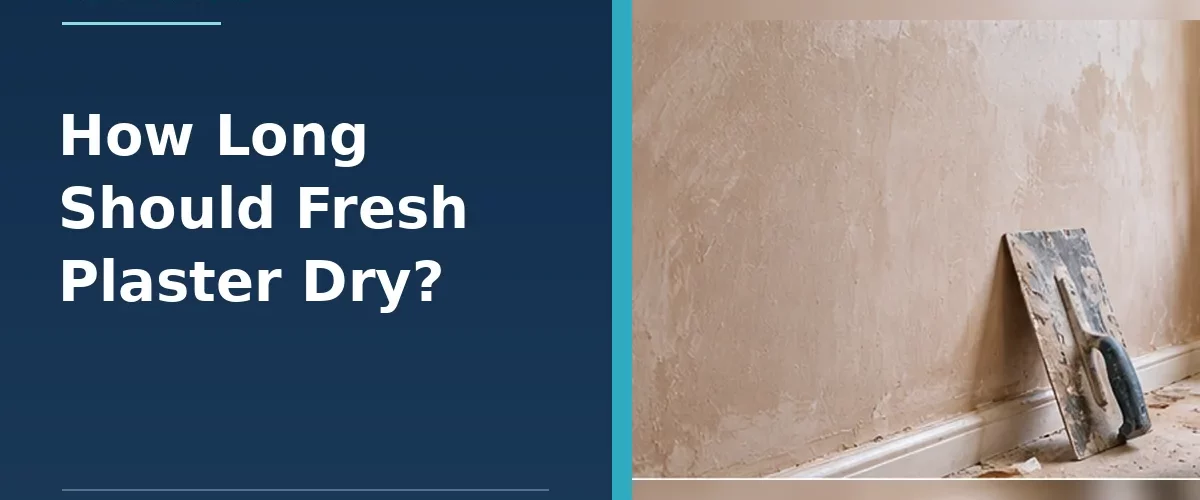
The Tile Association advises allowing gypsum plaster to cure for a minimum of four weeks before tiling, ensuring that it is dry and the finish is flush and plumb. This is a useful UK baseline, not permission to tile onto plaster that is still damp after four weeks. Conditions such as humidity, temperature and thickness can make drying take longer.
Why must new plaster dry before tiling?
Gypsum plaster retains moisture after application. Tiling before it is sufficiently dry can impair adhesive bonding and lock moisture into the wall assembly. Newly plastered surfaces may also be dusty or too weak for heavy tiles if they were poorly prepared.
What about a thin skim coat?
Don’t assume a skim coat can be tiled after only a few days simply because it changes colour. Follow the plaster manufacturer’s instructions and The Tile Association’s guidance. A substrate must be cured, sufficiently dry and capable of supporting the combined tile and adhesive weight.
How to tell whether plaster is ready
- Confirm how long ago the plaster was applied and the exact product used.
- Check the manufacturer’s curing and drying recommendations and the tiling-system compatibility.
- Look for persistent dark patches, condensation, softness or dampness. A uniformly paler surface is a clue, not a definitive test.
- Check the wall is firm, well-bonded, flat, free of loose powder and undamaged.
- Use an appropriate moisture assessment where required by the adhesive or substrate manufacturer.
How much weight can tiled plaster hold?
The permissible combined tile-and-adhesive weight is different for gypsum plaster, unskimmed plasterboard and specialist tiling boards. Do not rely on the commonly quoted plasterboard figure for a skimmed wall. Consult the current guidance from the substrate and adhesive suppliers before choosing heavy large-format porcelain or stone.
Do you need to prime plaster before tiling?
Often a system-approved primer is required on a gypsum background to manage suction and provide compatibility with a cement-based adhesive. The correct primer depends on the substrate and adhesive. Do not use ordinary PVA as a tiling primer; The Tile Association explicitly advises against it. Follow the product data sheet for application and drying.
Fresh plaster in a shower area
Plaster by itself is not a waterproof backing for a shower. The wet area needs a properly designed waterproofing or tanking system with suitable substrate preparation and compatible adhesives. Read our shower tanking guide for the key details.
Before you start: a quick checklist
- Minimum curing guidance and manufacturer-specific times satisfied.
- Wall is fully dry, stable, clean and reasonably flat.
- Tile and adhesive loads suit the background.
- Correct primer or waterproof membrane selected.
- Movement joints and adjoining materials considered.
- No unresolved dampness or hidden plumbing leaks.
Frequently asked questions
Can I tile fresh plaster after one week?
This is earlier than The Tile Association’s minimum four-week guidance for gypsum plaster. Wait until the requirements are met.
Can I speed up drying with a heater?
Forced heat can cause uneven drying or damage. Provide normal ventilation and follow the plaster manufacturer’s curing guidance instead.
Do I need to remove paint before tiling?
Painted plaster needs a separate bond assessment; see our tiling onto painted surfaces guide.
Is plasterboard quicker than plaster?
Suitable unskimmed plasterboard in a dry area may be tiled under the board and adhesive manufacturers’ instructions, subject to the correct load capacity and preparation. This is not equivalent to shower waterproofing.
Reference: The Tile Association technical FAQs.