The best way to avoid uneven edges on large-format floor tiles is to start with a very flat substrate and achieve a well-supported adhesive bed. Levelling clips can assist with alignment, but they cannot flatten a wavy screed, repair a loose floor or eliminate natural bowing in the tiles.
What counts as a large-format tile?
The term is used differently by suppliers, but commonly includes 600 × 600 mm tiles, long planks and larger porcelain panels. As tile length increases, small irregularities in floor flatness become more apparent, and moving or accurately bedding the tile requires greater care.
Why does lippage happen?
Lippage means one tile edge sits higher than its neighbour. Common contributors include an uneven substrate, insufficient or inconsistent bedding, tile warpage, incorrect grout joint planning and forcing a tile into position after the adhesive has begun to set.
Tools and materials
Long straightedge, spirit or laser level, tile spacers, manufacturer-approved adhesive, appropriate notched trowel, suction cups for larger tiles, levelling clip system where appropriate, suitable cutting equipment and protective gear. Use additional people or lifting frames for heavy large panels.
How to lay large-format tiles step by step
- Check floor flatness. Use a straightedge in multiple directions. Correct high and low spots with an approved levelling or repair system that has cured before tiling.
- Review the tile batch. Check actual size, flatness and the manufacturer’s recommended laying pattern. Large rectangular tiles may show lippage when installed in a 50% brick-bond pattern.
- Plan layout and movement joints. Balance perimeter cuts and preserve joints required by the substrate, heating and floor size.
- Choose a suitable adhesive. Porcelain, panel size, underfloor heating and substrate may require a classified deformable or large-format adhesive.
- Apply parallel ridges. Comb adhesive consistently; where required, key a compatible adhesive layer into the back of the tile, with ridges aligned in the prescribed direction.
- Bed and check. Place the tile and move it appropriately to collapse the ridges. Lift a trial tile to inspect coverage, especially along edges and corners.
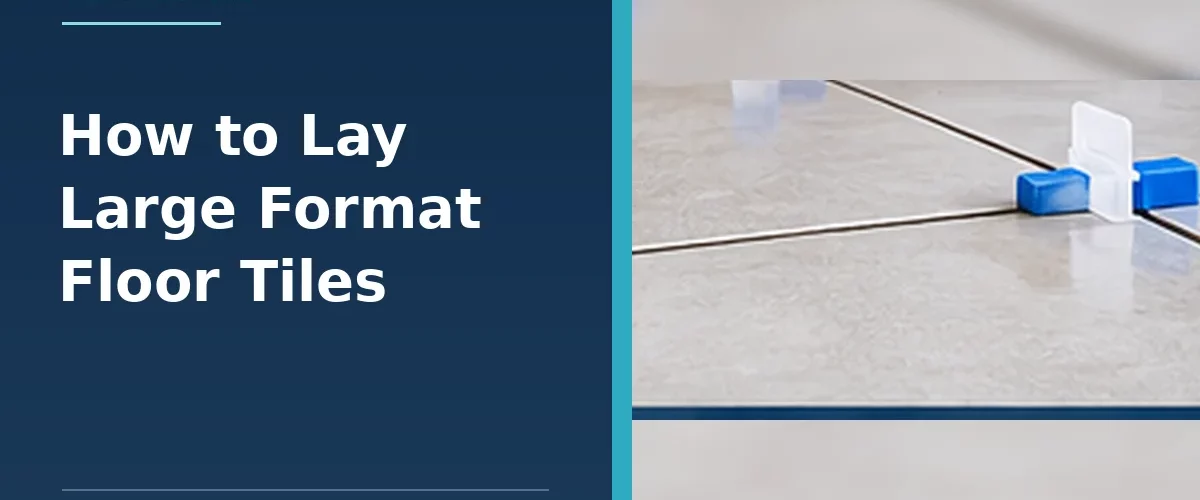
- Control lippage. Use spacers and clips as aids, checking each edge with a straightedge rather than over-tightening clips.
- Allow curing. Respect load, grouting and heating restart times. Remove clips at the specified time and grout properly.
Do tile levelling clips work?
Clips can keep neighbouring edges better aligned while the adhesive cures. They will not correct a significant floor hump or compensate for a tile that is insufficiently bedded. Never pull a tile out of its designed adhesive thickness simply to align an edge.
Can you lay large tiles over underfloor heating?
Yes, with a suitable engineered build-up that accounts for thermal movement. The Tile Association highlights the need for solid-bed fixing, appropriate adhesives and careful movement-joint design for large formats with heating.
Frequently asked questions
What is the best laying pattern for long porcelain tiles?
Check the manufacturer’s specified maximum offset. A third-offset or staggered pattern may reduce the visual effect of tile bowing compared with a half-offset layout.
Can thick adhesive fix an uneven floor?
Only within the adhesive’s permitted bed range and installation guidance. Significant unevenness should be corrected beforehand.
Do I need two people to lay large tiles?
Large or heavy panels can require team lifting and specialist frames to prevent injury and breakage.
How do I know if the tile has enough adhesive?
Lift a freshly bedded trial tile and confirm the specified solid coverage; unsupported corners or uncollapsed ridges are warning signs.
Related: What To Do If Your Tiles Are Uneven. Technical source: The Tile Association: fixing large format tiles.